I Ching 29 Meaning: Repeated Water Without a Disaster Forecast
I Ching 29 Meaning: Repeated Water Without a Disaster Forecast. Distinguish the repeated Kan figure, translation choices, and changing-line context from frightening
Quick Answer: I Ching Hexagram 29 is repeated Kan: water above water in the conventional sequence. It can frame a reflection on recurring difficulty, but it is not evidence that a disaster will occur. Read the figure, the passage, and any changing lines within the original question.
The repeated Kan figure and its source facts
- Hexagram number
- 29 in the conventional King Wen sequence.
- Trigram pairing
- Kan below Kan, commonly associated with water.
- Figure order
- Broken, solid, broken, broken, solid, broken, bottom to top.
- Translation variants
- Repeated Water, The Abysmal, and related renderings are interpretive labels.
- Reading boundary
- A literary and cultural reflection, not a risk forecast.
The repeated Kan figure and its source
The English title The Abysmal can sound alarming when encountered without its literary setting. A search for what does I Ching 29 mean should not end with a warning detached from a casting. Start with the repeated figure and the particular text, then decide what, if anything, makes sense as a reflection on the situation you actually asked about.
In the conventional King Wen order, number 29 is Kan repeated. From bottom to top, its lines are broken, solid, broken, broken, solid, broken. The two three-line groups are therefore the same. The Chinese text in the public-domain Yi Jing edition identifies this as the twenty-ninth hexagram and describes repeated Kan.
Different translators choose labels such as Repeated Water or The Abysmal. A label is an editorial rendering, not the whole passage. Consult Hexagram 29 in the primary text. This guide summarizes its setting; it does not offer a newly authenticated translation.
What the water image can and cannot tell you
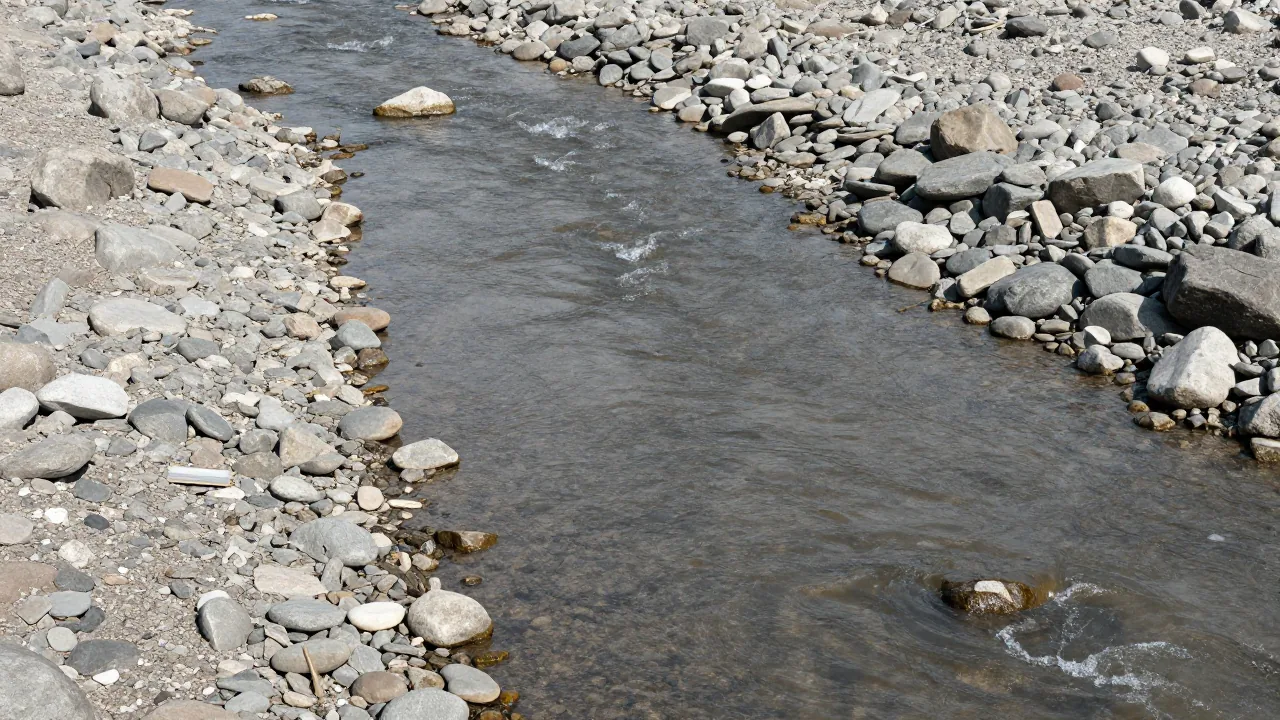
The water image can prompt a question about a difficulty that recurs or a route that needs steady attention. That is a modern reflective use, not a measurement of external danger. A river photograph or an evocative title cannot establish a forecast.
If the original question concerned a missed handoff at work, consider what part of the process repeats. It might be an unclear owner or an incomplete record. Those possibilities must be checked against ordinary evidence. Do not replace an actual safety assessment with a symbolic image, and do not infer that another person has harmful intentions because the figure feels severe.
The repetition in Hexagram 29 is structural before it is personal. Its upper and lower trigrams are both Kan, commonly rendered as water. That tells a reader how the figure is composed; it does not tell them that two bad events will occur. Keep those two statements on different lines in your notes. A structural observation can be checked against the six-line figure, whereas a claim about future events would need independent evidence that the figure does not provide. Even a vivid image of a narrow channel is an interpretive illustration, not a photograph of your circumstances or a warning issued by the text.
Read the judgment before selecting a line
The judgment, image commentary, and individual line texts are different parts of a reading. The primary text contains both recurring-danger language and attention to conduct and continuity. Selecting only a frightening sentence leaves out its immediate context. Choosing only a reassuring sentence creates a different distortion.
Read the complete relevant passage in one identified edition. Note which words belong to its translator and which are your own paraphrase. If you cannot read the Chinese source, identify the English translation you actually use rather than presenting a mixture of online quotations as one classical voice.
Imagine someone asking about a project that repeatedly stalls at the same approval stage. They might use repeated water as a prompt to identify the recurring constraint: an unclear requirement, an unavailable decision-maker, or a task that exceeds the time budget. None of these explanations follows automatically from drawing 29. The useful work is comparing the metaphor with observable details. If the obstacle turns out to be a missing document, completing that document is a practical response whether or not the symbolism feels fitting. If there is no recurring obstacle, do not manufacture one to make the reading sound accurate.
Changing lines belong to a specific casting
A hexagram figure alone does not tell a reader which positions changed. Preserve the six line values from the casting before discussing a line. Number positions from the bottom. If no changing lines were recorded, do not add a line because its wording happens to fit a worry.
Approaches to multiple changing lines vary. Declare the approach rather than silently choosing whichever passage sounds most relevant. The relating figure, when the recorded changes produce one, is additional context within that approach. It is not proof that a future event has been fixed. A missing casting record is a reason to narrow the explanation.
A second reading of the same question can introduce a different kind of confusion. Suppose the first result is 29 with one moving line and the next result is another hexagram. That is a new record, not a correction proving that the first result was wrong. Write down which method produced each figure, the order of the six line values, and the question asked on each occasion. If you changed the question between readings, preserve that change too. Repeated casting until a reassuring phrase appears makes it difficult to distinguish the original consultation from your later preference for an answer.
A modern example: repeated obstacles rather than certain disaster
Suppose the question is how to respond to a repeated delay in a volunteer project. A bounded reflection might compare the repeated Kan image with the repeated missed handoff, then ask what small part can be made more reliable. One possible next step is to confirm who owns the next task and when a status update is needed.
That step comes from the project's practical circumstances, not from a claim that Hexagram 29 commands it. Record alternatives too: perhaps the deadline is unrealistic, or information is arriving late. The reading can organize questions, while observation and conversation supply the evidence for a decision.
Separate an author's commentary from the passage being discussed. A book may print the judgment, an image statement, line texts, and several pages of explanation together. A beginner can accidentally attribute the whole spread to the ancient text. Record the translator or edition and the part you are paraphrasing. When two translations disagree, compare the particular phrase and its place in the figure rather than averaging their predictions. This article uses repeated water as a bounded reading theme; it does not offer a new translation of every line or a rule for choosing among competing schools of interpretation.
Moving-line practice also depends on a stated convention. Some readers consult each moving line, others prioritize a selected line or use an additional rule when several lines move. If you have not selected a convention, the number of moving lines is not a license to combine whichever passages seem most relevant. Note the convention first, then distinguish the primary figure, the line commentary, and any relating figure derived by changing the moving lines. Their relationship belongs to the recorded reading procedure. It should not be presented as three separate confirmations of the same real-world claim.
Questions for a bounded Hexagram 29 reading
Before closing the note, ask whether the water association helped identify a question or merely increased fear. Can the proposed response be explained without invoking supernatural certainty? Have the changing lines been preserved accurately? Would a different translation change the wording but leave the underlying concern recognizable?
A reading about a medical, legal, financial, mental-health, or safety issue must not replace qualified help. For a beginner, understanding the figure's relation to the question is enough; it is unnecessary to force every image onto a person or to turn the last line read into a compulsory instruction.
Repeated Water is most useful here as a carefully attributed literary image. A good reading note keeps the casting intact and ends with a question that can be examined in ordinary life, not a disaster forecast.
A useful stopping point is a question you can investigate without another cast. For the stalled project, that could be asking which requirement remains unmet, checking a deadline with the responsible person, or writing a smaller next action. For an emotionally difficult situation, it could be setting aside the reading and speaking with someone qualified to help. The symbolism may help organize reflection, but it cannot establish whether a risk is real or how urgent it is. When an actual emergency, health concern, legal obligation, or financial decision is involved, use the relevant evidence and professional support rather than a favorable or unfavorable hexagram.
Figure, passage, and casting: reading summary
- Figure: Kan below Kan. Record: six lines bottom to top. Reading: identified edition plus original question. Limit: reflection, not danger assessment.
FAQ: Reading Hexagram 29
Is Hexagram 29 always a bad sign?
No fixed good-or-bad label substitutes for the text, question, and recorded lines. It does not prove an impending event.
Is Kan repeated the same as two different water hexagrams?
It means Kan appears as both the lower and upper trigram in one six-line figure.
Can I choose a line without having a casting?
You can study a passage as literature, but should not claim it was a changing line in a casting that was never recorded.
Do I need to translate The Abysmal literally into my situation?
No. Name the translation and distinguish its imagery from your own reflective associations.
Can 29 assess whether a river trip is safe?
No. Use actual conditions, competent advice, and relevant safety information rather than a divination result.