Book of Changes: A Calm Way to Begin Reading the I Ching
Learn what the Book of Changes is, how an I Ching reading record works, and how to use a hexagram as reflection rather than certainty.
The Book of Changes, often called the I Ching, is a classic text used with hexagrams as a framework for reflection. A beginner can start with one clear question, a simple record, and a grounded next step rather than a prediction claim.
The text, the reading, and the boundary
- Classic text and origin
- The Book of Changes is the common English name for the I Ching, a Chinese classic organized around 64 hexagrams.
- Reading tradition materials
- A beginner can use a translation, three coins, and a notebook; the record matters more than elaborate equipment.
- Hexagram record
- Write the question, date, coin results, and the hexagram before looking for an interpretation.
- Modern reflection use
- A reading can help someone notice a pattern, tension, or question worth considering more carefully.
- Interpretation boundary
- A hexagram does not replace evidence, consent, professional advice, or a decision made by the reader.
The Book of Changes in cultural context
The Book of Changes is the name many English readers use for the I Ching. It is a Chinese classic built around sixty-four hexagrams, each made from six broken or unbroken lines. Over a long history, readers have approached it as a text about change, relationship, timing, and reflection rather than as a machine that settles every question on demand.
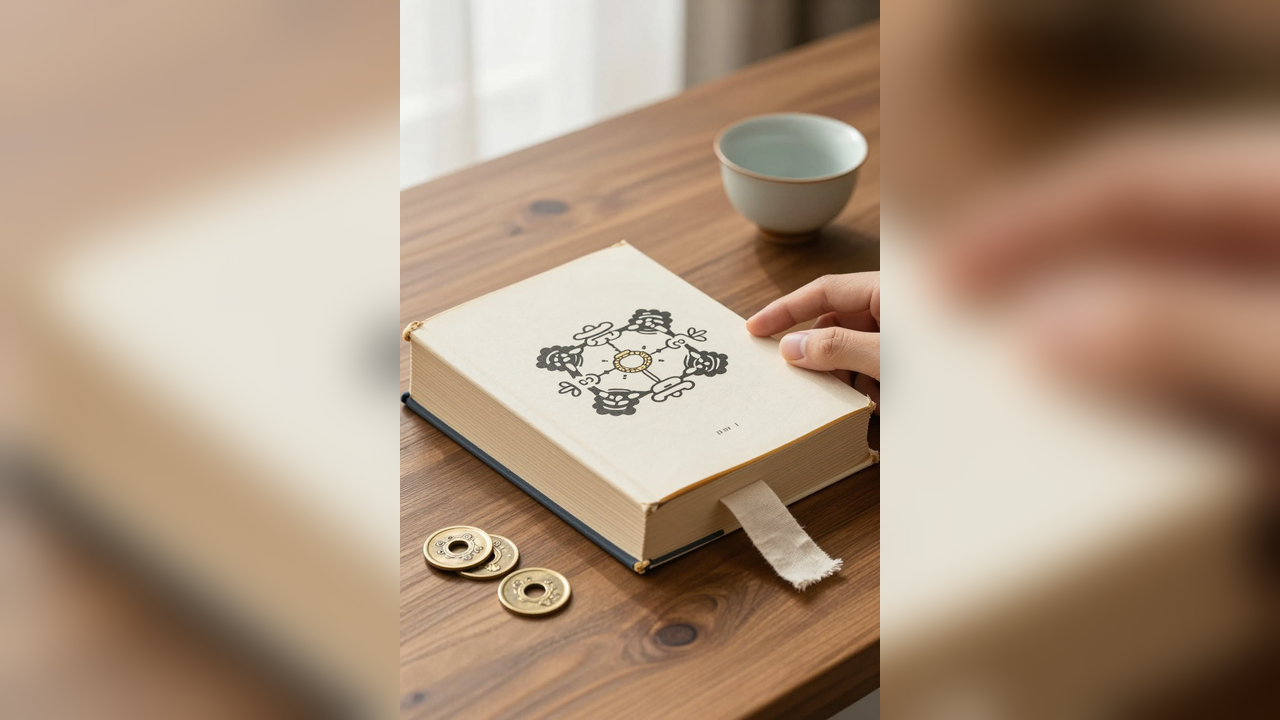
For a first encounter, it helps to keep the objects in view: a book or reliable translation, a quiet question, and a way to record what happened. The physical setup slows the process down. Instead of hunting for a dramatic answer, a reader can notice what the wording brings into focus and compare it with the situation already in front of them.
That is also the useful boundary. The I Ching has cultural and historical depth, but a reading is not evidence that a future outcome is guaranteed. It can make a question more precise; it cannot make a choice on someone else's behalf.
Begin with one question and one reading record
Start with a question that names a situation you can actually describe. 'What should I notice before I change jobs?' gives you something to reflect on. 'Tell me exactly what will happen' asks the book to do a job it cannot do. A bounded question leaves room for observation, uncertainty, and your own responsibility.
If you use three coins, write down the question and date first. Record each throw in order, then note the resulting lines before turning to the text. A notebook is useful because memory changes quickly after an emotionally charged reading. The page lets you see what was present before you began interpreting it.
There is no prize for a complicated ritual. A clear record of one question, one cast, and one first response is enough for a beginner. It also makes it easier to return later and decide whether the reading helped you see the situation more carefully.

Read a hexagram as a pattern to reflect on
A hexagram is not a personality label or a verdict. It is a pattern of six lines that gives a reader a structured place to begin. Read the name, the main text, and any moving-line material in your edition slowly. Then ask what part of the situation the language makes more visible: pace, conflict, cooperation, preparation, or a limit you had overlooked.
Different translations use different wording, so avoid forcing a single phrase to carry more certainty than it has. Compare the text with the question you wrote down. If an interpretation seems to demand an expensive, risky, or irreversible action, step away from the book and look for ordinary evidence before acting.
A helpful note can be modest: 'This made me notice I have not asked my colleague for the missing information.' That kind of observation keeps the reading connected to a real situation without turning symbolic language into an instruction.
Keep the next step outside the book
Close the book before deciding what to do next. Read your question and note again, then name one action that exists in the everyday world: make a call, gather a document, wait for a reply, talk with the person involved, or seek qualified advice. The action should be reasonable even for someone who never consults the I Ching.
This pause is especially important when the subject is health, money, safety, legal rights, or another person's consent. A reading may give language for reflection, but it should not replace professional judgment, direct communication, or verifiable information.
Keeping the next step outside the book protects the value of the reading as well. It lets the text remain a companion for thought while you stay responsible for the choices that affect your life and other people.

A quiet first-reading routine
- Write one clear question about a situation you can describe.
- Keep the book, coins, and notebook together before you begin.
- Record the date and each coin result before reading commentary.
- Underline one phrase that connects to the actual situation, not a prediction you want.
- Choose one ordinary next action that still makes sense without the reading.
New-reader questions about the Book of Changes
Is the Book of Changes the same as the I Ching?
Yes. Book of Changes is a common English name for the I Ching, the Chinese classic associated with hexagrams and changing lines.
Do I need coins to read the Book of Changes?
No. Coins are one familiar way to form a hexagram, but a translation and a clear record are more important than owning a special set.
What should a beginner write down after a reading?
Write the question, date, method, hexagram or line record, one phrase you noticed, and one real-world action you may take or investigate.
Can the Book of Changes make a decision for me?
No. It can offer a structure for reflection, but it cannot replace evidence, consent, professional advice, or your responsibility for a decision.